
Articles
EFSA Sets Out How Paid External Experts Support Food-Safety Work
Published on 4 August 2026, EFSA’s REE framework explains how individual scientific advisers and operational specialists can be hired for defined food-safety assignments.
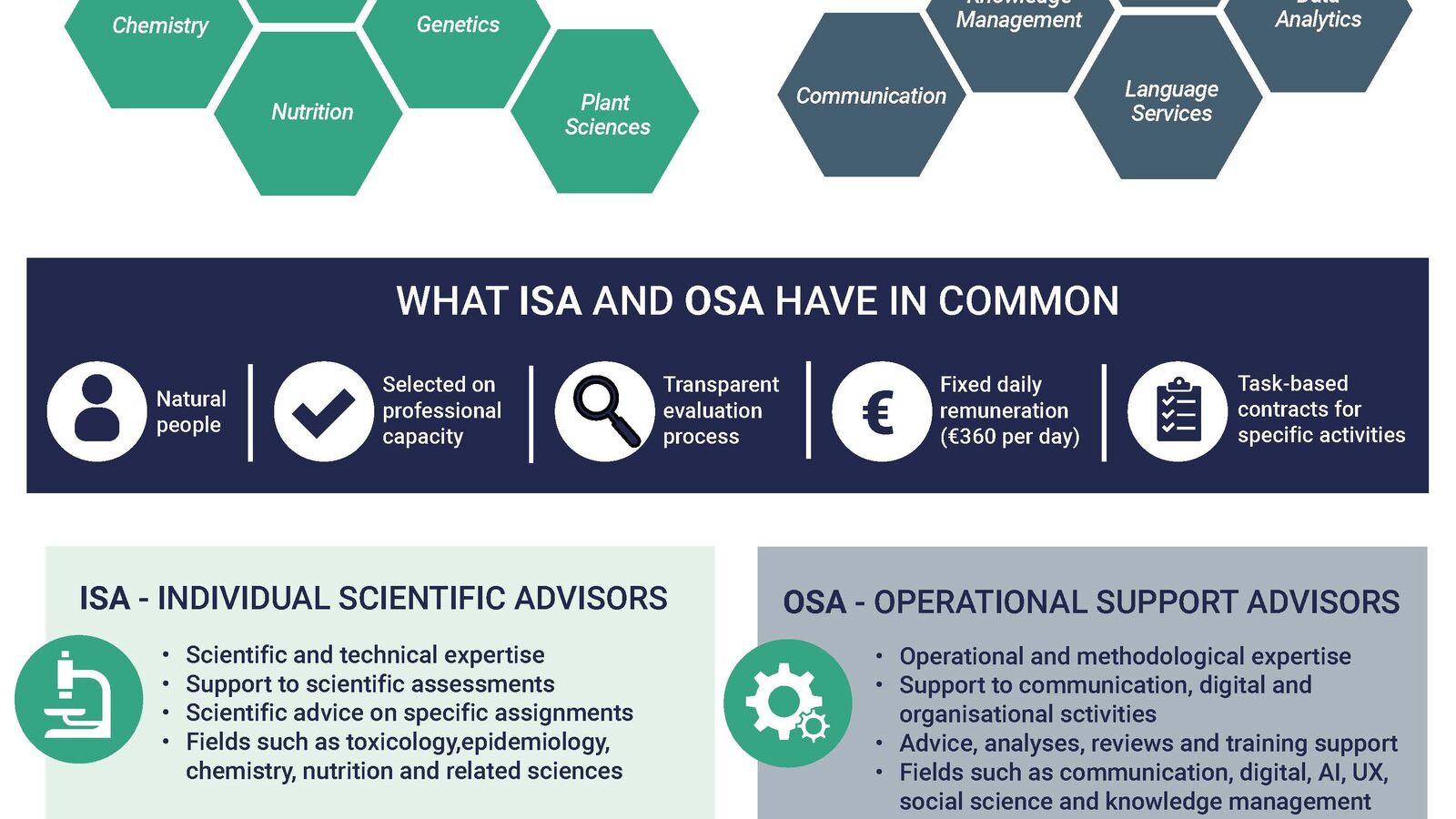
EFSA has published a description of its Remunerated External Experts (REE) framework, explaining how the authority can bring in specialist support when a particular scientific or operational need arises. Published on 4 August 2026, the framework concerns the organisation of expert input behind defined assessment and support tasks. It does not introduce new cooking guidance or a new finding about a food, ingredient or household practice.
Two routes for specialist support
The REE framework uses two complementary routes. ISA is intended for individual scientific advisers, while OSA covers operational support advisers. EFSA says external experts may provide scientific, technical, operational and methodological advice.
That distinction gives the framework two separate functions. ISA supports the substance of scientific work, including assessments and opinions on specific assignments. OSA supports the communication, digital and organisational work that surrounds the handling and delivery of expert information.
What ISA advisers can cover
ISA advisers support scientific assessments and give opinions on defined assignments. EFSA lists fields including toxicology, risk assessment, epidemiology, chemistry, nutrition, genetics and plant sciences.
The range covers both laboratory-focused disciplines and broader assessment fields. An ISA engagement can therefore be matched to a specific scientific requirement rather than relying on one general category of expertise. The framework describes the route, while the substance of any resulting advice depends on the assignment given to the adviser.
What OSA advisers can cover
OSA has a different remit. Its listed areas include user experience and design, social sciences, digital and artificial intelligence, knowledge management, data analysis, communication and language services.
OSA advisers can support communication, digital and organisational activities and provide advice, analysis, reviews and training. Their role concerns how information is processed, presented and supported as well as the operational work around it. This makes OSA relevant to the delivery of expert work, not only to the scientific assessment itself.
Selection, pay and contract limits
Both arrangements are open to individuals selected for their professional competence, and EFSA presents the evaluation process as transparent. The daily remuneration is €360.
Contracts are made for specific tasks and define the exact scope, duration and price of each engagement. That limits an adviser’s role to the work covered by the contract: what the assignment includes, how long it runs and what it costs are set out in advance.
What this means for food-safety readers
The immediate significance of the REE framework is structural. It gives EFSA a way to obtain targeted expertise across scientific disciplines and operational fields when a defined need arises. The framework itself does not establish a new position on an ingredient, food category or household practice.
Any direct effect on consumers would come through the particular assessment, advice or support task an expert is hired to perform. For now, the announcement explains the machinery behind specialist support: ISA covers individual scientific advice, while OSA covers operational support. The €360 daily rate and task-specific contracts make the arrangement concrete, but its practical impact will depend on the assignments and outputs that follow.
Official sources
Sources
- Official source: efsa.europa.eu
- https://www.efsa.europa.eu/en/infographics/remunerated-external-experts-ree